
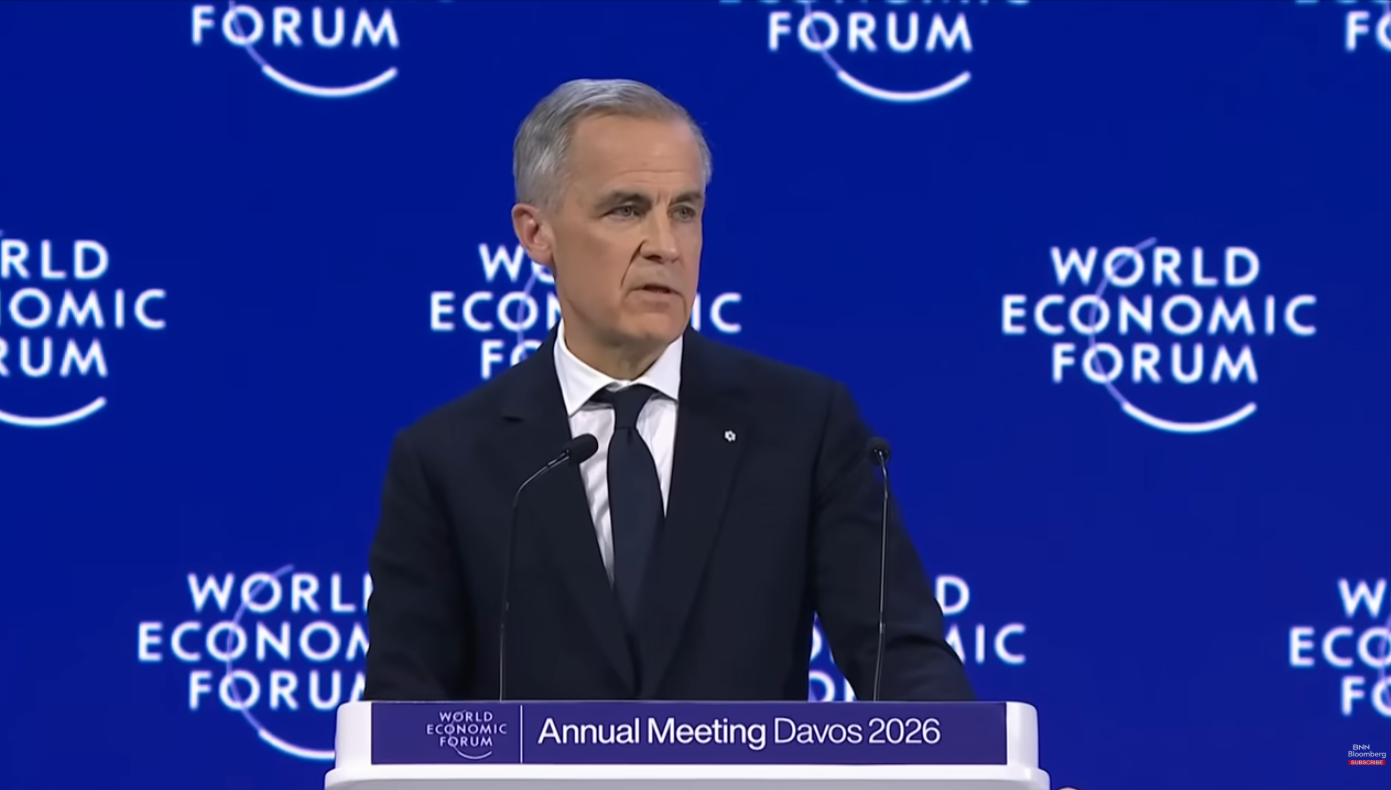
The speech by Canadian Prime Minister Carney at the WEF in Davos in 2026 is a great source of inspiration for Europe, for a new form of European patriotism with a multipolar outlook. Carney said: “The system’s power comes not from its truth, but from everyone’s willingness to perform as if it were true. And its fragility comes from the same source. When even one person stops performing, when the greengrocer removes his sign, the illusion begins to crack.”
Thank you very much, Larry. I’m going to start in French, and then I’ll switch back to English.
(IN FRENCH)
It seems that every day we’re reminded that we live in an era of great power rivalry — that the rules-based order is fading, that the strong can do what they can, and the weak must suffer what they must.
And this aphorism of Thucydides is presented as inevitable, as the natural logic of international relations reasserting itself. And faced with this logic, there is a strong tendency for countries to go along, get along to accommodate, to avoid trouble, to hope that compliance will buy safety.
Well, it won’t. So what are our options?
In 1978, the Czech dissident Václav Havel, later president, wrote an essay called “The Power of the Powerless,” and in it he asked a simple question: how did the communist system sustain itself?
And his answer began with a greengrocer.
Every morning, the shopkeeper places a sign in his window: “Workers of the world unite.” He doesn’t believe in it. No one does. But he places the sign anyway to avoid trouble, to signal compliance, to get along. And because every shopkeeper on every street does the same, the system persists — not through violence alone, but through the participation of ordinary people in rituals they privately know to be false.
Havel called this living within a lie. The system’s power comes not from its truth, but from everyone’s willingness to perform as if it were true. And its fragility comes from the same source. When even one person stops performing, when the greengrocer removes his sign, the illusion begins to crack.
Friends, it is time for companies and countries to take their signs down.
For decades, countries like Canada prospered under what we called the rules-based international order. We join its institutions, we praised its principles, we benefited from its predictability. And because of that, we could pursue values-based foreign policies under its protection.
We knew the story of the international rules-based order was partially false, that the strongest would exempt themselves when convenient, that trade rules were enforced asymmetrically, and we knew that international law applied with varied rigor, depending on the identity of the accused or the victim.
This fiction was useful, and American hegemony in particular helped provide public goods, open sea lanes, a stable financial system, collective security, and support for frameworks for resolving disputes.
So we placed the sign in the window. We participated in the rituals, and we largely avoided calling out the gaps between rhetoric and reality.
This bargain no longer works.
Let me be direct. We are in the midst of a rupture, not a transition.
Over the past two decades, a series of crises in finance, health, energy and geopolitics have laid bare the risks of extreme global integration. But more recently, great powers have begun using economic integration as weapons, tariffs as leverage, financial infrastructure as coercion, supply chains as vulnerabilities to be exploited.
You cannot live within the lie of mutual benefit through integration when integration becomes the source of your subordination.
The multilateral institutions on which the middle powers have relied — the WTO, the UN, the COP, the very architecture of collective problem solving — are under threat. As a result, many countries are drawing the same conclusions that they must develop greater strategic autonomy in energy, food, critical minerals, in finance and supply chains. And this impulse is understandable.
A country that cannot feed itself, fuel itself, or defend itself has few options. When the rules no longer protect you, you must protect yourself.
But let’s be clear-eyed about where this leads. A world of fortresses will be poorer, more fragile, and less sustainable.
And there’s another truth: if great powers abandon even the pretense of rules and values for the unhindered pursuit of their power and interests, the gains from transactionalism will become harder to replicate.
Hegemons cannot continually monetize their relationships. Allies will diversify to hedge against uncertainty. They’ll buy insurance, increase options in order to rebuild sovereignty, sovereignty that was once grounded in rules but will increasingly be anchored in the ability to withstand pressure.
This room knows this is classic risk management. Risk management comes at a price, but that cost of strategic autonomy, of sovereignty, can also be shared. Collective investments in resilience are cheaper than everyone building their own fortresses. Shared standards reduce fragmentations. Complementarities are positive sum.
The question for middle powers like Canada is not whether to adapt to the new reality — we must.
The question is whether we adapt by simply building higher walls, or whether we can do something more ambitious.
Now, Canada was amongst the first to hear the wake-up call, leading us to fundamentally shift our strategic posture. Canadians know that our old, comfortable assumptions that our geography and alliance memberships automatically conferred prosperity and security, that assumption is no longer valid. And our new approach rests on what Alexander Stubb, the president of Finland, has termed value-based realism.
Or, to put it another way, we aim to be both principled and pragmatic. Principled in our commitment to fundamental values, sovereignty, territorial integrity, the prohibition of the use of force except when consistent with the UN Charter and respect for human rights.
And pragmatic in recognizing that progress is often incremental, that interests diverge, that not every partner will share all of our values.
So we’re engaging broadly, strategically, with open eyes. We actively take on the world as it is, not wait around for a world we wish to be.
We are calibrating our relationships so their depth reflects our values, and we’re prioritizing broad engagement to maximize our influence, given the fluidity of the world at the moment, the risks that this poses and the stakes for what comes next.
And we are no longer just relying on the strength of our values, but also the value of our strength.
We are building that strength at home. Since my government took office, we have cut taxes on incomes, on capital gains and business investment. We have removed all federal barriers to interprovincial trade. We are fast tracking $1 trillion of investments in energy, AI, critical minerals, new trade corridors and beyond. We’re doubling our defence spending by the end of this decade, and we’re doing so in ways that build our domestic industries. And we are rapidly diversifying abroad.
We’ve agreed to a comprehensive strategic partnership with the EU, including joining SAFE, the European defence procurement arrangements. We have signed 12 other trade and security deals on four continents in six months.
In the past few days, we’ve concluded new strategic partnerships with China and Qatar. We’re negotiating free trade pacts with India, ASEAN, Thailand, Philippines and Mercosur.
We’re doing something else: to help solve global problems, we’re pursuing variable geometry. In other words, different coalitions for different issues based on common values and interests. So on Ukraine, we’re a core member of the Coalition of the Willing and one of the largest per capita contributors to its defence and security.
On Arctic sovereignty, we stand firmly with Greenland and Denmark and fully support their unique right to determine Greenland’s future.
Our commitment to NATO’s Article 5 is unwavering, so we’re working with our NATO allies, including the Nordic-Baltic Eight, to further secure the alliance’s northern and western flanks, including through Canada’s unprecedented investments in over-the-horizon radar, in submarines, in aircraft, and boots on the ground — boots on the ice.
Canada strongly opposes tariffs over Greenland and calls for focused talks to achieve our shared objectives of security and prosperity in the Arctic.
On plurilateral trade, we’re championing efforts to build a bridge between the Trans-Pacific partnership and the European Union, which would create a new trading bloc of 1.5 billion people on critical minerals.
We’re forming buyer’s clubs anchored in the G7 so the world can diversify away from concentrated supply. And on AI, we’re cooperating with like-minded democracies to ensure that we won’t ultimately be forced to choose between hegemons and hyperscalers.
This is not naïve multilateralism, nor is it relying on their institutions. It’s building coalitions that work issue by issue with partners who share enough common ground to act together. In some cases, this will be the vast majority of nations. What it’s doing is creating a dense web of connections across trade, investment, culture on which we can draw for future challenges and opportunities.
Our view is the middle powers must act together because if we’re not at the table, we’re on the menu.
But I’d also say that great powers can afford, for now, to go it alone. They have the market size, the military capacity, and the leverage to dictate terms. Middle powers do not. But when we only negotiate bilaterally with a hegemon, we negotiate from weakness. We accept what’s offered. We compete with each other to be the most accommodating.
This is not sovereignty. It’s the performance of sovereignty while accepting subordination.
In a world of great power rivalry, the countries in-between have a choice: compete with each other for favour, or combine to create a third path with impact. We shouldn’t allow the rise of hard power to blind us to the fact that the power of legitimacy, integrity, and rules will remain strong if we choose to wield it together.
Which brings me back to Havel. What does it mean for middle powers to live the truth?
First, it means naming reality. Stop invoking rules-based international order as though it still functions as advertised. Call it what it is: a system of intensifying great power rivalry where the most powerful pursue their interests using economic integration as coercion.
It means acting consistently, applying the same standards to allies and rivals. When middle powers criticize economic intimidation from one direction but stay silent when it comes from another, we are keeping the sign in the window.
It means building what we claim to believe in, rather than waiting for the old order to be restored. It means creating institutions and agreements that function as described, and it means reducing the leverage that enables coercion.
That’s building a strong domestic economy. It should be every government’s immediate priority.
And diversification internationally is not just economic prudence; it’s a material foundation for honest foreign policy, because countries earn the right to principled stands by reducing their vulnerability to retaliation.
So, Canada. Canada has what the world wants. We are an energy superpower. We hold vast reserves of critical minerals. We have the most educated population in the world. Our pension funds are amongst the world’s largest and most sophisticated investors. In other words, we have capital talent. We also have a government with immense fiscal capacity to act decisively. And we have the values to which many others aspire.
Canada is a pluralistic society that works. Our public square is loud, diverse and free. Canadians remain committed to sustainability. We are a stable and reliable partner in a world that is anything but, a partner that builds and values relationships for the long term.
And we have something else: we have a recognition of what’s happening and determination to act accordingly. We understand that this rupture calls for more than adaptation. It calls for honesty about the world as it is.
We are taking a sign out of the window.
We know the old order is not coming back. We shouldn’t mourn it. Nostalgia is not a strategy, but we believe that from the fracture we can build something bigger, better, stronger, more just. This is the task of the middle powers, the countries that have the most to lose from a world of fortresses and the most to gain from genuine cooperation.
The powerful have their power. But we have something too: the capacity to stop pretending, to name realities, to build our strength at home, and to act together.
That is Canada’s path. We choose it openly and confidently, and it is a path wide open to any country willing to take it with us.
Thank you very much.
Watch the full speech here: https://www.youtube.com/watch?v=DegxfB_siZM
VERSIONE ITALIANA:
Il discorso del premier canadese Carney al WEF di Davor, 2026, è una grande ispirazione per l’Europa, per un nuovo patriottismo europeo di taglio multipolare. Ha detto Carney: “Il potere del sistema non deriva dalla sua verità, ma dalla disponibilità di tutti a comportarsi come se fosse vero. E la sua fragilità nasce dalla stessa fonte. Quando anche una sola persona smette di recitare, quando il droghiere toglie il cartello, l’illusione comincia a incrinarsi.”
Grazie mille, Larry. Comincerò in francese e poi tornerò all’inglese.
(IN FRANCESE)
Sembra che ogni giorno ci venga ricordato che viviamo in un’epoca di rivalità tra grandi potenze — che l’ordine internazionale basato sulle regole sta svanendo, che i forti fanno ciò che possono e i deboli devono subire ciò che devono.
E questo aforisma di Tucidide viene presentato come inevitabile, come la logica naturale delle relazioni internazionali che si riafferma. E di fronte a questa logica, esiste una forte tendenza, per i Paesi, ad adeguarsi, ad accomodarsi, a evitare i problemi, a sperare che la conformità possa comprare sicurezza.
Ebbene, non funzionerà. Quali sono allora le nostre opzioni?
Nel 1978, il dissidente ceco Václav Havel, poi presidente, scrisse un saggio intitolato Il potere dei senza potere, nel quale pose una domanda semplice: come faceva il sistema comunista a sostenersi?
E la sua risposta cominciava con un droghiere.
Ogni mattina, il negoziante espone nella vetrina un cartello: «Proletari di tutto il mondo, unitevi». Non ci crede. Nessuno ci crede. Ma lo espone comunque per evitare guai, per segnalare conformità, per andare avanti senza problemi. E poiché ogni negoziante in ogni strada fa lo stesso, il sistema persiste — non solo attraverso la violenza, ma grazie alla partecipazione delle persone comuni a rituali che sanno intimamente essere falsi.
Havel chiamò tutto questo “vivere nella menzogna”. Il potere del sistema non deriva dalla sua verità, ma dalla disponibilità di tutti a comportarsi come se fosse vero. E la sua fragilità nasce dalla stessa fonte. Quando anche una sola persona smette di recitare, quando il droghiere toglie il cartello, l’illusione comincia a incrinarsi.
Amici, è tempo che imprese e Paesi tolgano i loro cartelli.
Per decenni, Paesi come il Canada hanno prosperato sotto quello che chiamavamo l’ordine internazionale basato sulle regole. Abbiamo aderito alle sue istituzioni, ne abbiamo lodato i principi, abbiamo beneficiato della sua prevedibilità. E grazie a questo, abbiamo potuto perseguire politiche estere basate sui valori sotto la sua protezione.
Sapevamo che la narrazione dell’ordine internazionale basato sulle regole era in parte falsa, che i più forti si sarebbero esentati quando conveniente, che le regole commerciali venivano applicate in modo asimmetrico e che il diritto internazionale veniva applicato con rigore variabile, a seconda dell’identità dell’accusato o della vittima.
Questa finzione era utile e l’egemonia americana, in particolare, ha contribuito a fornire beni pubblici: rotte marittime aperte, un sistema finanziario stabile, sicurezza collettiva e sostegno a quadri per la risoluzione delle controversie.
Così abbiamo messo il cartello in vetrina. Abbiamo partecipato ai rituali e, in larga misura, evitato di denunciare le discrepanze tra retorica e realtà.
Questo patto non funziona più.
Permettetemi di essere diretto. Siamo nel mezzo di una rottura, non di una transizione.
Negli ultimi due decenni, una serie di crisi finanziarie, sanitarie, energetiche e geopolitiche ha messo a nudo i rischi di un’integrazione globale estrema. Ma più recentemente, le grandi potenze hanno iniziato a usare l’integrazione economica come arma, i dazi come leva, le infrastrutture finanziarie come coercizione, le catene di approvvigionamento come vulnerabilità da sfruttare.
Non si può vivere nella menzogna del beneficio reciproco attraverso l’integrazione quando l’integrazione diventa la fonte della propria subordinazione.
Le istituzioni multilaterali su cui le potenze medie hanno fatto affidamento — l’OMC, l’ONU, le COP, l’intera architettura della risoluzione collettiva dei problemi — sono sotto minaccia. Di conseguenza, molti Paesi stanno giungendo alla stessa conclusione: devono sviluppare una maggiore autonomia strategica nell’energia, nel cibo, nei minerali critici, nella finanza e nelle catene di approvvigionamento. E questo impulso è comprensibile.
Un Paese che non può nutrire se stesso, alimentare se stesso o difendere se stesso ha poche opzioni. Quando le regole non ti proteggono più, devi proteggerti da solo.
Ma guardiamo con lucidità dove porta tutto questo. Un mondo di fortezze sarà più povero, più fragile e meno sostenibile.
E c’è un’altra verità: se le grandi potenze abbandonano anche solo la pretesa di regole e valori per perseguire senza freni il proprio potere e i propri interessi, i guadagni del transazionalismo diventeranno sempre più difficili da replicare.
Le potenze egemoni non possono monetizzare all’infinito le proprie relazioni. Gli alleati diversificheranno per proteggersi dall’incertezza. Compreranno assicurazioni, aumenteranno le opzioni per ricostruire la sovranità, una sovranità che un tempo era fondata sulle regole ma che sarà sempre più ancorata alla capacità di resistere alle pressioni.
Questa sala sa che si tratta di una classica gestione del rischio. La gestione del rischio ha un costo, ma quel costo dell’autonomia strategica, della sovranità, può anche essere condiviso. Gli investimenti collettivi nella resilienza sono meno costosi che costruire ognuno la propria fortezza. Gli standard condivisi riducono la frammentazione. Le complementarità generano benefici per tutti.
La domanda per le potenze medie come il Canada non è se adattarsi alla nuova realtà — dobbiamo farlo.
La domanda è se ci adattiamo semplicemente costruendo muri più alti o se possiamo fare qualcosa di più ambizioso.
Il Canada è stato tra i primi a sentire il campanello d’allarme, il che ci ha portati a modificare profondamente la nostra postura strategica. I canadesi sanno che le vecchie e comode convinzioni secondo cui la nostra geografia e l’appartenenza alle alleanze garantivano automaticamente prosperità e sicurezza non sono più valide. Il nostro nuovo approccio si fonda su ciò che Alexander Stubb, presidente della Finlandia, ha definito realismo basato sui valori.
O, detto in altro modo, puntiamo a essere sia guidati dai principi sia pragmatici. Guidati dai principi nel nostro impegno verso i valori fondamentali, la sovranità, l’integrità territoriale, il divieto dell’uso della forza se non in conformità con la Carta delle Nazioni Unite e il rispetto dei diritti umani.
E pragmatici nel riconoscere che il progresso è spesso incrementale, che gli interessi divergono e che non tutti i partner condivideranno tutti i nostri valori.
Ci impegniamo quindi in modo ampio e strategico, a occhi aperti. Affrontiamo attivamente il mondo per quello che è, non restiamo ad aspettare il mondo che vorremmo.
Stiamo calibrando le nostre relazioni affinché la loro profondità rifletta i nostri valori e stiamo dando priorità a un impegno ampio per massimizzare la nostra influenza, data la fluidità del mondo in questo momento, i rischi che ciò comporta e la posta in gioco per ciò che verrà.
E non ci affidiamo più solo alla forza dei nostri valori, ma anche al valore della nostra forza.
Stiamo costruendo questa forza in patria. Da quando il mio governo è entrato in carica, abbiamo ridotto le tasse sui redditi, sulle plusvalenze e sugli investimenti delle imprese. Abbiamo rimosso tutte le barriere federali al commercio interprovinciale. Stiamo accelerando investimenti per mille miliardi di dollari in energia, intelligenza artificiale, minerali critici, nuovi corridoi commerciali e oltre. Raddoppieremo la spesa per la difesa entro la fine di questo decennio spiegandola in modo da rafforzare le nostre industrie nazionali. E stiamo rapidamente diversificando all’estero.
Abbiamo concordato un partenariato strategico globale con l’Unione Europea, compresa l’adesione a SAFE, il sistema europeo di appalti per la difesa. Abbiamo firmato altri 12 accordi commerciali e di sicurezza in quattro continenti in sei mesi.
Negli ultimi giorni, abbiamo concluso nuovi partenariati strategici con la Cina e il Qatar. Stiamo negoziando accordi di libero scambio con l’India, l’ASEAN, la Thailandia, le Filippine e il Mercosur.
Stiamo facendo anche un’altra cosa: per contribuire a risolvere i problemi globali, perseguiamo una geometria variabile. In altre parole, coalizioni diverse per questioni diverse, basate su valori e interessi comuni. Così, sull’Ucraina, siamo membri centrali della Coalizione dei Volenterosi e tra i maggiori contributori pro capite alla sua difesa e sicurezza.
Sulla sovranità dell’Artico, siamo fermamente al fianco della Groenlandia e della Danimarca e sosteniamo pienamente il loro diritto unico a determinare il futuro della Groenlandia.
Il nostro impegno verso l’Articolo 5 della NATO è incrollabile, quindi stiamo lavorando con i nostri alleati NATO, compresi i Paesi nordico-baltici, per rafforzare ulteriormente i fianchi settentrionale e occidentale dell’Alleanza, anche attraverso gli investimenti senza precedenti del Canada in radar oltre l’orizzonte, sottomarini, aerei e presenza militare sul terreno — sul ghiaccio.
Il Canada si oppone fermamente ai dazi sulla Groenlandia e chiede colloqui mirati per raggiungere i nostri obiettivi condivisi di sicurezza e prosperità nell’Artico.
Sul commercio plurilaterale, stiamo promuovendo gli sforzi per costruire un ponte tra il Partenariato Trans-Pacifico e l’Unione Europea, creando un nuovo blocco commerciale di 1,5 miliardi di persone nei minerali critici.
Stiamo formando club di acquirenti ancorati al G7 affinché il mondo possa diversificare lontano da forniture concentrate. E sull’intelligenza artificiale, stiamo cooperando con democrazie affini per garantire che non saremo costretti a scegliere tra egemoni e hyperscaler.
Questo non è multilateralismo ingenuo, né un affidamento cieco alle istituzioni esistenti. È la costruzione di coalizioni che funzionano, questione per questione, con partner che condividono abbastanza terreno comune da poter agire insieme. In alcuni casi, si tratterà della stragrande maggioranza delle nazioni. Ciò che stiamo creando è una fitta rete di connessioni tra commercio, investimenti e cultura, da cui potremo attingere per le sfide e le opportunità future.
La nostra visione è che le potenze medie debbano agire insieme perché, se non siamo al tavolo, siamo nel menu.
Ma direi anche che le grandi potenze, per ora, possono permettersi di agire da sole. Hanno la dimensione del mercato, la capacità militare e la leva per dettare le condizioni. Le potenze medie no. E quando negoziamo solo bilateralmente con un egemone, negoziamo da una posizione di debolezza. Accettiamo ciò che ci viene offerto. Competiamo tra di noi per essere i più accomodanti.
Questa non è sovranità. È la messa in scena della sovranità mentre si accetta la subordinazione.
In un mondo di rivalità tra grandi potenze, i Paesi intermedi hanno una scelta: competere tra loro per il favore altrui oppure unirsi per creare una terza via con un impatto reale. Non dovremmo permettere che l’ascesa del potere duro ci accechi rispetto al fatto che il potere della legittimità, dell’integrità e delle regole rimarrà forte se scegliamo di esercitarlo insieme.
E questo mi riporta a Havel. Che cosa significa, per le potenze medie, vivere nella verità?
Innanzitutto, significa chiamare la realtà con il suo nome. Smettere di invocare l’ordine internazionale basato sulle regole come se funzionasse ancora come pubblicizzato. Chiamarlo per ciò che è: un sistema di rivalità crescente tra grandi potenze, in cui i più forti perseguono i propri interessi usando l’integrazione economica come strumento di coercizione.
Significa agire in modo coerente, applicando gli stessi standard agli alleati e ai rivali. Quando le potenze medie criticano l’intimidazione economica da una parte ma restano in silenzio quando proviene da un’altra, stiamo mantenendo il cartello in vetrina.
Significa costruire ciò in cui dichiariamo di credere, invece di aspettare che il vecchio ordine venga ripristinato. Significa creare istituzioni e accordi che funzionino come dichiarato e ridurre le leve che consentono la coercizione.
Questo vuol dire costruire un’economia domestica forte. Dovrebbe essere la priorità immediata di ogni governo.
E la diversificazione internazionale non è solo prudenza economica; è una base materiale per una politica estera onesta, perché i Paesi si guadagnano il diritto a posizioni di principio riducendo la propria vulnerabilità alle ritorsioni.
Dunque, il Canada. Il Canada ha ciò che il mondo desidera. Siamo una superpotenza energetica. Deteniamo vaste riserve di minerali critici. Abbiamo la popolazione più istruita al mondo. I nostri fondi pensione sono tra i più grandi e sofisticati investitori globali. In altre parole, abbiamo capitale e talento. Abbiamo anche un governo con un’enorme capacità fiscale per agire con decisione. E abbiamo valori a cui molti altri aspirano.
Il Canada è una società pluralista che funziona. Il nostro spazio pubblico è rumoroso, diversificato e libero. I canadesi restano impegnati nella sostenibilità. Siamo un partner stabile e affidabile in un mondo che stabile non è affatto, un partner che costruisce e valorizza relazioni di lungo periodo.
E abbiamo qualcos’altro: la consapevolezza di ciò che sta accadendo e la determinazione ad agire di conseguenza. Comprendiamo che questa rottura richiede più di un adattamento. Richiede onestà sul mondo per quello che è.
Stiamo togliendo il cartello dalla vetrina.
Sappiamo che il vecchio ordine non tornerà. Non dovremmo rimpiangerlo. La nostalgia non è una strategia, ma crediamo che dalla frattura si possa costruire qualcosa di più grande, migliore, più forte e più giusto. Questo è il compito delle potenze medie, dei Paesi che hanno più da perdere in un mondo di fortezze e più da guadagnare da una cooperazione autentica.
I potenti hanno il loro potere. Ma anche noi abbiamo qualcosa: la capacità di smettere di fingere, di nominare le realtà, di costruire la nostra forza in patria e di agire insieme.
Questa è la strada del Canada. La scegliamo apertamente e con fiducia, ed è una strada aperta a qualunque Paese disposto a percorrerla con noi.
Grazie mille.
Author